26 November 2000
Magic, music and me …
By Patricia Deevy
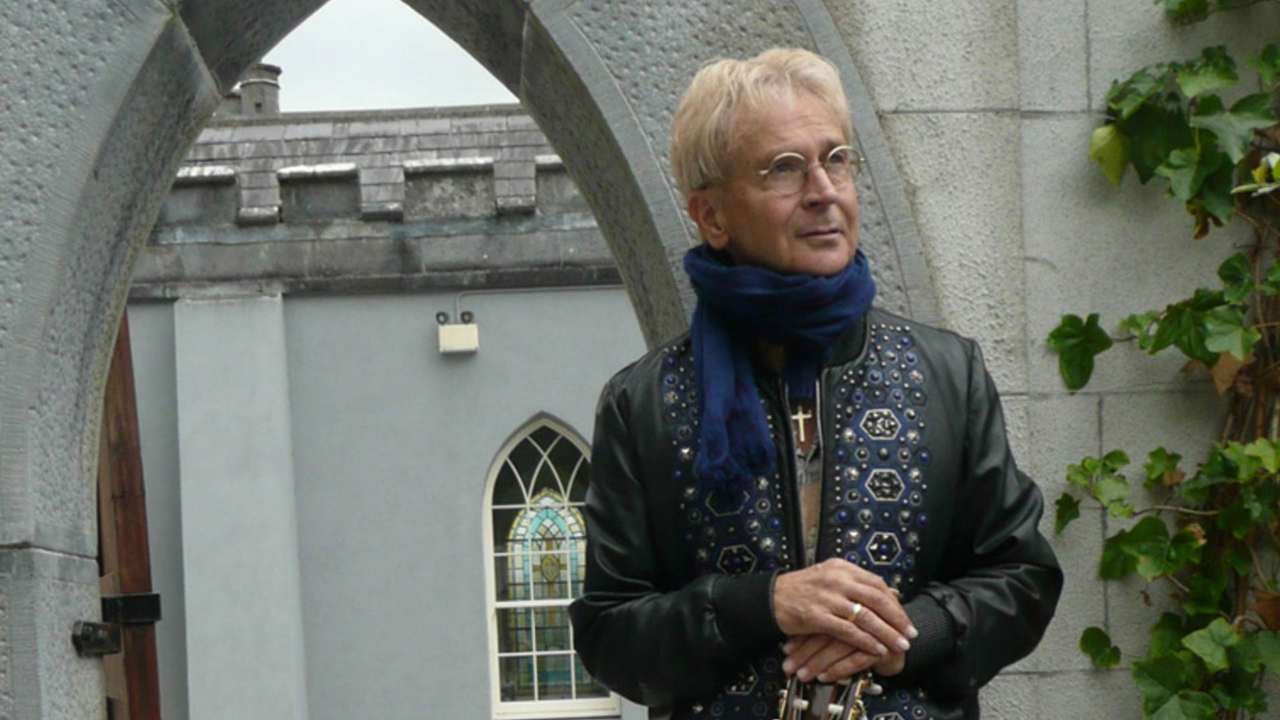
Jimmy McCarthy is responsible for some of the most famous and popular songs of contemporary times. And yet it’s other people Christy Moore, Mary Black who get to sing his memorable melodies. But he’s not bothered; after troubled times, he’s having the best time of his life. He tells Patricia Deevy about this moment of transition
JIMMY MacCarthy is making one observation but ends up illustrating another one entirely, which is that is he is a pernickety fellow. He is explaining how writing songs while drinking alcoholically can make you emotionally reckless: “You do it so that it’s finished and you can go and have a drink and the editing faculty is eliminated completely. I recognise that. A lot of things that people would take out I would let it go, like ‘the geek with the alchemist’s stone’ [from Bright Blue Rose]. They’re all little acts of bravery.
“And lines like: ‘Run the claw along my gut one last time,’ which is the correct line in Ride On, whereas Christy [Moore] has ‘run your claw’; it was never ‘your claw’.”
This is not surprising. From his songs, Jimmy MacCarthy is clearly particular. He is intense, romantic and in love with dense semantic, syllabic and symbolic structures. His melodies manage to be both complicated and catchy. He calls some of what he does “sean nós pop”. While his best songs are complete in a way that is rare and satisfying, sometimes he wanders dangerously close to utter self-absorption. He knows this himself because he says that out of the 1,000-odd songs he has written, more than half are too complex, too personal or too biting to become public. “The best of my language will never get out.”
Although MacCarthy keeps a low profile, every year he does a handful of gigs, one of which takes place at Dublin’s HQ tonight. But this one marks a moment of transition. A new studio in a coverted cowshed at his Wicklow home is being set up to record his third album. A new label, Ride On Records, has been launched with his promoter Pat Egan to record up-and-coming singers doing new material of his. The venerable company Waltons is about to issue a songbook, No Frontiers: The Songs of Jimmy MacCarthy. And, what fun, Angel’s Wings, a song he co-wrote for Westlife’s new album, is to be released as a single.
It is a time of anticipation and of anxiety: “I am not in the whole of myself at the moment because the ‘What if I should fail?’ is here again and the ‘What if I should fail?’ is part of that caution which I believe is the prerequisite for success.”
Apart from his distracted playing with a big bunch of keys, there is every reason to believe MacCarthy when he says that this is the best time of his life. About five years go he bought the house and land in Wicklow, spent a few years working on it so that outside it is a model stable rad and inside has a spartan bachelor’s comfort. What is missing in the rambling mini-mansion is untidiness or evidence of the heavy usage it needs to breathe properly.
In his kitchen he makes me tea and has Kombucha, the health drink, himself. Post-AA, he is interested in healthy living, alternative medicine, healing and meditation. He has also run through various gurus, people such as Louise L Hay (healing yourself), John Bradshaw (the inner child), and a slew of 12-step programmes. But he can take them and then leave them. “People can be obsessive about it.” He has stick with the Alexander Technique (a postural and breathing programme), which has given him confidence, and has used the I Ching for 18 years.
From the beginning, the loves of Jimmy MacCarthy’s life were horses and music. A delicate child in his early years, he was brought up by his maternal grandfather, James Manley, in Millstreet, for four years. Whatever you might think about maternal deprivation, MacCarthy has nothing but good to speak of this time and of life with his beloved grandfather, and points out that Cork wasn’t far away and they always visited. And he remembers Manley putting him on a horse when he was a tot. “It was a magical feeling and I still associate riding horses with magic.”
RETURNING home to Wilton, he was soon absorbed into the hurly-burly of family life. The MacCarthy business was transportation distributing newspapers and magazines all over Munster and the house was always full of children (eventually there were 12 MacCarthy offspring), drivers and office staff. There were happy times: flush during the Sixties boom one year, their father, Ted, installed a swimming pool for the kids as their Christmas present. Later, after losing the business, from a combination of bad health and bad luck, the MacCarthy parents still made sure things were good for their children.
At 15, MacCarthy left school, where he was unhappy, and became a stable boy at Vincent O’Brien’s place in Ballydoyle. The early plan was to aim for a training career but after five years between Tipperary and Newmarket, MacCarthy returned home to help his father. When Ted MacCarthy’s bad heart lead to the end of the business, his son was able to make a living from pub-singing at night. He grew up loving Elvis Presley, The Beatles, The Supremes, Smokey Robinson and “very especially” Dusty Springfield. Covering their songs with his big voice was no problem. “I was doing quite well until I replaced the ser with a total set of original material,” he says.
For most of his 20s and into his 30s, then, he made his living busking on the London Underground and from occasional slots opening other people’s gigs in Ireland. Record companies weren’t interested. It was Christy Moore’s recording of Ride On, a song Moore had been given three years earlier, that made MacCarthy.
He was away, and unaware, when Ride On became an Irish hit. Back in the country, he decided to drop into a Moore gig. “I stood at the back wall of Connolly Hall and about five or six numbers in he sang Ride On and the whole place sang it with him. And I thought: ‘What is this?’ The hairs stood on the back of my neck. So I thought: ‘that is it. All these people, Christy Moore fans, they’re singing it, they’re singing this language and they don’t seem to think there’s anything wrong with it.’ I was absolutely on air.”
While its meaning was not absolutely obvious, Ride On’s key emotion was clear: it was a song of parting. “The people who do not know what parting is do not exist in the world.” As he explains the layers of this and other songs of his, MacCarthy rattles off verses, whole songs, like poems he has learned by rote.
Having left school even without the Inter Cert, he began reading in his 20s. “I became very fascinated with the idea od words and the elasticity of words and the beauty of them. I love the idea of songs being beautiful. For me, beautiful songs decorate the walls of the world we live in.” Despite loving language, he is not an avid reader: “It’s an inspirational thing with me. I’m much more inspirational than perspirational. I’m self-educated. I got on with it.” In moments of doubt about what he was writing, odd phrases that were coming to him, he has turned to the poet and fount of knowledge, Theo Dorgan.
IN so far as he bears any signs of his early intellectual deprivation, it is an over-earnest disposition, an anxiety about his image. He says he couldn’t write a funny song, and after making a mild, vaguely risqué quip, makes me promise not to include it because “it’s not really me”.
And finally, another sign of having a hard-won confidence in his absolute pride. “There’s no piece of work that is out there that I’m not proud of.” Having written so many hits including Missing You, The Contender, Mystic Lipstick, As I Leave Behind Neidin, Katie, Adam at the Window and Wonder Child a more relaxed man would give himself permission to joke about the ones that got away. Among the hundreds, there must be some.
The process of writing is exacting and sometimes torturous. No lyric is ever thrown away, and it may take 15 years to write a song. “How long it takes is irrelevant as long as you don’t do anything wrong. That’s the idea of caution. Caution is definitely the prerequsiite for success. All you have to do is don’t do the wrong thing. Time is irrelevant.”
That his best-known songs have been made famous by other sings, particularly Christy Moore and Mary Black, he doesn’t mind. “I learned how to let songs go with Ride On. Christy’s version was very different to mine, but he was true to the melody and he was true to the words. I see two types of singers who interpret. There’s people who skim around the surface and there are those who deep-sea dive. Christy Moore is a deep-sea diver. He goes right to the heart of what a song is about. I like the deep-sea divers. I think I’m a deep-sea diver myself.”
Having said that he doesn’t mind other people singing his songs, he talks a lot about the changes they made to his lyrics. This came to a head when he realised that Mary Black had recorded No Frontiers but omitted the last four lines: “And heaven has its way/ When all will harmonise/ And know what’s in our hearts/ The dream will realise.”
“That is the kernel of the song. Without that there is no heart. I said ‘If you put it out, I’ll stop you.’ And we had a legal battle and I stopped them. There was bad blood for years after that, very bad blood. Which is a shame because we were having success. I think her first mainstream hit was Katie.”
MacCarthy was still drinking when he wrote Ride On at the beginning of the Eighties. “I was guaranteed by my drinking buddies that if I stopped drinking that I’d dry up. And I really believed it.”
He had been drinking since he was 12. “I had a great time up to my late 20s and then I think I started experiencing alcohol-related depression where I just went very low. I lost enthusiasm for things. I went home to my dad who had been in the AA fellowship all our lives. My dad was a non-drinking alcoholic, with one or two slips.
“I went to my first few AA meetings with him and realised that a successful life is very much there when you embrace the philosophy and I embraced it with both hands. I would say that stopping drinking was a huge part of whatever success I’ve had because of my ability to deal with the world and to be well enough to write.”
MacCarthy says that his drinking came out of no great traumas. “In fact, the worst thing that ever happened to me was that my father died.” That was in early 1998.
“You regret the things then that happened when you were younger. You regret anything that wasn’t good. The bond between myself and my father was very, very strong and became extremely strong later on in his life. And that was a difficult thing to deal with.
“I sang at my father’s funeral. It was the most difficult thing I ever did in my life: I sang No Frontiers. It’s something that I had to do and I’m very grateful that I did that.”
IF his father was lively and always coming up with schemes, his mother, Betty is “warm and serene”. They were, he says, well matched. He recalls one night after a gig of his in Cork’s Everyman Palace walking along the street afterwards with a friend. “I looked up the road and there they were walking up the road holding hands and I thought: “It’s a lovely thing to see.’
“I would like that. I’m seeing somebody and all that but I’m not married and I’m 47. I could say that maybe I’m a confirmed bachelor but I hope not. I think it would be lovely to share your life with somebody and very especially to have a child. I think that’s a recurring thing that comes in some of the songs Wonder Child and stuff like that.
“I nearly got married when I was about 21. Went to see the priest and everything and I remember him being in some doubt as to whether or not I could afford to be married. And I said: ‘You’re probably right. What am I doing here?’ She went on and married a friend of mine later and they’re very happy and have a good life. That’s just the way life goes.”
Memorial cards for his father and grandfather sit on the window sill along with various religious artifacts which include a plastic holy water bottle in the shape of the Blessed Virgin, a crucifix and an angel. “It isn’t that I’m a very Catholic person or anything like that but I do have a great belief in the whole Christian ethic and Christ vibration thing.”
Many of his songs are saturated with spiritual sentiments which would not be out of place on a gospel album. Take the chorus of The Song of the Singing Horseman: “I want you, I want you/ In my life, my Lord/ I want you in my heart/ And on my word, my Lord/ I’d love you/ I’d love you/ In my life my Lord/ The child within my heart/ And on my word, my law.”
Bright Blue Rose is an invocation of spiritual perfection through Christ. It’s where the narrator MacCarthy describes himself as “the geek with the alchemist’s stone”, a strikiningly bleak portrait. He sees it as an attitude of humility.
“Well, the geek is one of the lowest forms of humanity. There’s nothing grandiose about being a geek. You are preaching to no one when you put yourself there. So basically I put myself above no one else.”
* Jimmy MacCarthy plays at HQ, Middle Abbey Street, Dublin 1 tonight. Doors open at 7pm.
– Irish Independent
 Jimmy MacCarthy